Protocol: connecting cultures through trust and guanxi
By Ina Kokinova
This interactive deep dive explores how protocol influences international cultural relations by communicating power, intentions and cultural diversity. More than a set of fixed rules, protocol is understood as a way of behaving in an adaptive way. After a brief historical overview, the piece analyses the EU-China 2025 Summit as a case study, reflecting on protocol’s persistence in the digital world, and giving visibility to the unnoticed but heavy work that protocol officials perform behind the scenes. While the focus is on diplomatic protocol, insights can be extrapolated to social, business, academic, sports and other settings.
George Bush Sr. vomited on Japanese Prime Minister Kiichi Miyazawa during a state banquet in 1992. At the 2009 G20 meeting, Silvio Berlusconi was greeted by the Obamas with a cold handshake instead of cheek kisses because of his remarks about their “tan”. In 2010, David Cameron's delegation refused Chinese officials’ request to remove their poppies: they may be worn in the UK to remember the war dead but in China they are associated with the British Opium Wars. Prince Philip, Duke of Edinburgh, was famously gaffe-prone. King Juan Carlos I scolded Venezuela’s Hugo Chavez for interrupting the Spanish Prime Minister at the 2007 Iberoamerican Summit shouting “¿Por qué no te callas?”. Donald Trump has humiliated several of his guests in the Oval Office in front of live TV, including ridiculing Ukraine’s Volodymyr Zelenskyy wartime wardrobe. Von der Leyen's confusion over the absence of a third chair at the 2021 meeting with Türkiye's Erdogan, presumably because of her gender, went down the books as Sofagate and still haunts coordination with the EU Council president. And many, many more…
Protocol only makes news headlines when something goes wrong. Depending on whether the breach of protocol was intentional or not, it may be resolved in private or through public protest, requiring an apology or, as the most extreme option, recalling ambassadors. Overstepping strict rules -e.g. on distance or serious composure- can also be a way of showing proximity and good relations. But when protocol is deliberately used to send a message, it becomes the effect rather than the cause of the conflict, such as the United States insulting China by sending a junior diplomat to discuss a proposed UN resolution condemning Israel in 2008.
Faux pas can also be less dramatic. But an individual slip or negligence can turn into a diplomatic incident.
Playing the wrong national anthem, hoisting the flag of a different country, mispronouncing a counterpart's name or title, violating order-of-precedence rules regarding table sitting plans or speeches order, gifting an item considered taboo in the recipient's culture, touching a counterpart in a culturally inappropriate way, off-script remarks or jokes that translate poorly...
Source: Model DiplomatBecause diplomats and politicians represent their countries abroad, their actions (even if travelling in private capacity) are perceived as the official position of that state. The low frequency of high-level meetings, such as head of state or government, raises the stakes: they are a rare opportunity to cause a good impression that generates the political will to improve relations. Regardless of countries’ cultural diplomacy strategies, the interactions between their representatives constitute intercultural relations that allow exchange of views, gaining mutual understanding and establishing trust.
Diplomatic protocol provides the framework for respectful and fair engagement between cultures with different conceptions of courtesy, punctuality, hierarchy, direct speech, focus on relations or tasks, food etiquette, among others (see anthropologists like Hofstede’s model or Hall’s low- and high-context cultures). Even though protocol is usually thought of as a rigid set of rules, it is actually a way of managing uncertainty and looking for peaceful resolution of differences, even when countries are in conflict or war. Protocol is thus inseparable from the art of diplomacy, understood as the application of intelligence and tact to the conduct of official relations.
As soon as humans formed groups, they started agreeing intra-group norms of social behaviour, as well as interacting with each other in order to exchange information, objects and people. Trade, art and marriages are evidence that humans were capable of negotiating and engaging peacefully, leading to the emergence of diplomacy. Protocol rules were soon needed to ensure the protection of envoys that connected different peoples ("Don't kill the messenger"). Peoples have always relied on symbols to communicate identity, status and allegiances, and it is the the common imaginary of the time that allows us to understand the meaning behind them: think of the bygone coats of arms -now incomprehensible to anyone without specialised heraldry training- as today’s logos known to the masses.
Early protocol was closely related to religion, including sacrifices and deification of rulers through clothes and jewellery, furniture and transport means, ceremonies and feasts. The tradition that ultimately inspired the birth of modern international relations began in ancient Greece. It was in the Renaissance that embassies ceased being only temporary, and until the advent of the telegraph and the telephone sped communications, diplomacy remained a slow-paced and highly autonomous activity, entrusted to an elite of emissaries who shared education, ideology and culture. Protocol became more diverse, and more complex, as countries gained independence from European colonial powers.
Click a location to see its contribution to diplomatic protocol, based on Encyclopedia Britannica.
International protocol with Chinese characteristics
The perdurability of Confucian values
Kǒng Qiū or Master Kong (孔夫子 Kǒngfuzǐ, 551-479 BC) is recognised as one of the great thinkers in the history of humanity. His most famous book, the Analects, postulates that in order become a superior human and behave appropriately in every situation, one must observe five regulations, one of them being ritual or ceremony (礼 lǐ).
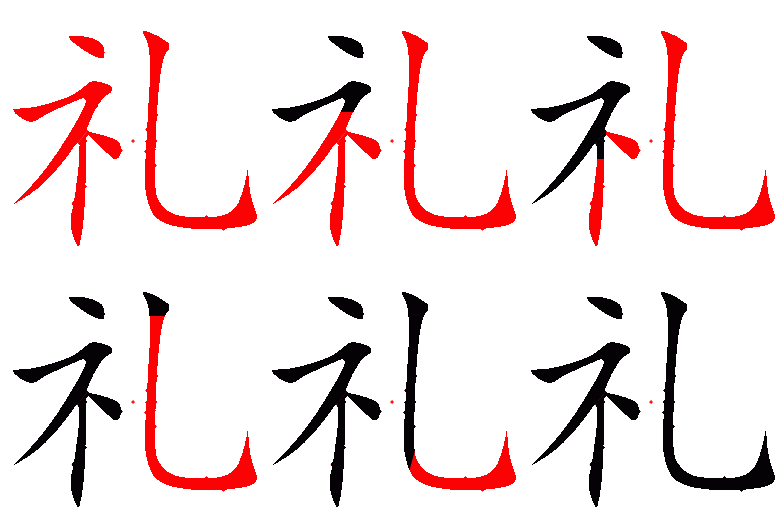
It is usually translated as righteousness, order and property in the context of cosmic harmony, or as customs, rules and good manners with regard to social conduct. A key characteristic is knowing how to behave in accordance with one's social status and the specific context, considering the possession of multiple identities. In this way, social norms maintain balance in the greater community, extending from the personal relationships (关系 guānxì) to the national level. In the Book of Rites (礼记 lǐji), the last chapter -although relatively short- is dedicated precisely to the “Meaning of the exchange of missions between different courts”. Rules with relevance to diplomacy are also scattered throughout the rest of the chapters.
The Confucian tradition dominated Chinese politics for more than twenty centuries (between the 2nd BC and 20th AD) due to its inherent adaptability and the flexible interpretation of later generations (although Confucianism is based on the observance of prescribed norms, the existence of tensions between concepts requires the ability to adapt and make the most appropriate decision for the specific situation). Confucian teachings were the basis of the education system and the exams for government positions, and also influenced the whole region. The values are so ingrained that they survived several purges, including by the Communist Party.
The clash with Western protocol
The Middle Kingdom had long circumscribed both foreign relations and commerce. Until the 15th century, the Silk Road constituted the main contact point between China and Europe, but contact was intermediated by merchants. In 1757, China concentrated it entirely at a single port: Macau. In 1792, Great Britain sent a trade mission with the aim of negotiating more beneficial conditions. The delegation was headed by colonial administrator Macartney and comprised three ships and more than 700 people, among which businessmen and diplomats. The journey from Macau to the capital in the north was hindered by the emperor's representatives and the audience was postponed several times until it was finally held in 1793.
The meeting between Macartney and Qianlong required meticulous protocol preparations, monopolised by the matter of kowtow, that is, the centuries-old act of kneeling and touching the ground with the head in a show of respect towards the emperor. Macartney refused to perform the humiliating gesture unless a Chinese officer carried out the same gesture before the portrait of the British king. The Chinese side rejected the proposal as it was incompatible with the notion of the superiority of the Son of Heaven. The emperor was about to cancel the meeting when it was agreed that Macartney should perform the European genuflection, but without kissing the emperor's hand because this would contravene his untouchable status. On the other hand, instead of bringing tribute as was expected of all vassals, Macartney insisted that these were gifts between equals.
After entertaining his guests, the emperor refused to comply with English demands for greater commercial exchange and permanent diplomatic representations, citing the uselessness of foreign objects and the breakdown of harmony through incivility. Thus, both sides ignored the need to understand the other's culture and diplomatic style.
From humiliation to great-power protocol, from European looting and admiration for Chinese culture to trade tensions
Although Macartney's mission is considered a complete failure, the British delegation had the opportunity to make detailed observations inside the Chinese empire, which would later be of great help in its defeat. In the conflict between Western and Chinese concepts of diplomatic protocol, Europeans prevailed by force of arms: in 1860, the second Opium War finished when the British and French sacked and pillaged the emperor’s summer palace and areas around Beijing. They refused to withdraw until the Chinese court had agreed to receive ambassadors on terms consistent with Western practices. The popular outrage at foreign influence led to the Boxer Revolution in 1900, but another European incursion ended up in exempting the Delegations Quarter from Chinese jurisdiction.
10 million artifacts are estimated to have been looted, with restitution still pending. Fascinated with the exotic, many European collectors filled their “cabinets of curiosities”, palaces furnished Chinese rooms, and the blue-and-white porcelain came to be known as “china”. These objects exposed the European public to Chinese culture (and protocol), complementing the limited production of European artists visiting China -accompanying trade missions-, but also inspired Orientalist, romanticised and patronising depictions.
Because modernity was associated with the West that was colonising and humiliating China, until the beginning of the 20th century, reforming ideas were always articulated within Confucian thought, insisting on the differentiation between the Chinese essence and the Western method. In 1911, the birth of the Chinese republic also started the transition of imperial protocol towards a Westernised one. Mao Zedong’s People’s Republic won the civil war in 1949 but his rival continued to speak for China in the UN until 1971, heralding a decades-long struggle over international recognition and representation. As China’s economic might grew, so did its power projection through diplomatic events, such as the 2008 Olympic Games or the G20 Hangzhou Meeting. The “wolf warrior” approach now seems to have been a temporary stunt in the “lovable” diplomatic strategy of a great power. Europe, however, is now reticent of Chinese imports flowing in, yet again straining the relationship over trade matters.
What is not optional: flexibility and problem solving
Protocol requires adapting to diverse settings, with unforeseen circumstances always popping up despite meticulous planning (e.g. the UNESCO meeting 2016 in Türkiye was suspended after an attempted coup d’etat, or bombs exploding close to Macron’s hotel during a historic visit to Syria, which also saw the return of 23 artifacts after 16 years on loan). The safety and security of the top officials are the utmost priority of any protocol officer, covering physical integrity, medical conditions, allergies and more. Protocol necessitates not only thinking through all the possible details and what could possibly go wrong, but accepting that something always does, and being prepared to deal with whatever occurs in order to prevent any embarrassment or conflict.
This mandates skills like common sense, discretion and interpersonal communication, which are not taught at university or courses offered by Ministries of Foreign Affairs, but rather acquired through years of experience in stressful situations. Breaches of etiquette cause so few international incidents partially because governments go to such lengths to prevent them. For example, staffers preparing for Nixon’s landmark 1972 visit to China became concerned that the president would suffer from rash, forcing him to scratch himself inappropriately during meetings with Chairman Mao. The crisis was averted when a Navy physician deduced that the lacquer on some Chinese toilets was causing the problem and advised the president to put a toilet-paper barrier between himself and the seats.
What was missing: EU Member States, cultural relations

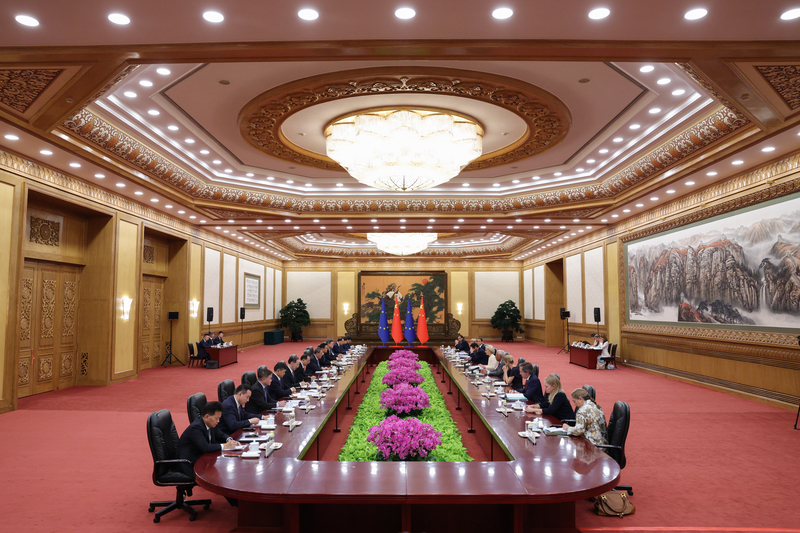
In 2023, von der Leyen and Emmanuel Macron traveled to China together in order to project European unity. However, different protocolary treatment was given to the two, with Macron enjoying airport and venue welcome by the foreign minister and Xi respectively, a packed schedule, a state banquet and positive media depictions. This reflected China’s preference to deal with EU Member States bilaterally rather than with the EU, often dubbed a “divide and conquer” tactic. It also paved the way for the EU going solo in 2025.
On the other hand, with politicians’ attention being absorbed by global conflicts, like Russia’s large-scale invasion of Ukraine or USA and Israel’s war in Iran, and the EU taking a page out of Beijing’s book by focusing its external action on Global Gateway investments in infrastructure, green and digital, while denouncing the increasing trade deficit, there is less and less room in bilateral meetings for human rights, education or people-to-people exchanges, thus stagnating EU-China cultural relations.
Every element of diplomatic protocol may signal political and symbolic stances, but its main purpose remains to enable state representatives to talk and reach an agreement, that is, intentional bidirectional exchange. Communicating about its outcomes to their national public and global audiences is therefore a key aspect of summits. This requires close coordination between protocol, press, communications and other officials. It is also worth remembering that media coverage is shaped not only through official press releases and conferences, but also (intentional) leaks to the press. In the runup to the 2025 summit, China and the EU purposefully lowered the expectations with the view of reducing the risk of disappointment and criticism, but the tactics were not successful in limiting negative coverage.
Media sentiment analysis performed over 40 news and analytical articles can be summarised as mixed, with a slightly negative tilt. It confirms that Western (and Taiwanese) media were more critical of the EU-China Summit, stressing tensions or insufficient results and sometimes even mistrust, while Chinese outlets emphasised mutual respects and the need for and benefits of cooperation. Articles from other parts of the world present a more mixed picture. Thus, the central divide is not whether dialogue should continue, but whether the meeting had a positive impact on the underlying relationship. China South Morning Post was the media with the most pieces covering the summit, totalling more than 10, including before and after it happened, with formats ranging from news, through opinion to editorials as part of the special anniversary coverage.
Sentiment analysis was done with Formula Bot, an AI-powered tool specialised in marketers and analysts.
Outlet bias has been consulted via Media Bias/Fact Checker, and where available reconciled with AllSides bias ratings.
As mentioned in the beginning, protocol only gets media attention when something goes wrong. The articles do mention diplomatic choreography, especially the choice of Beijing rather than Brussels as host city after Xi rejected the initial invitation, the duration reduction from two to one day, the joint statement limited to climate and the lack of joint press conference. But there is rarely any reporting about itineraries, flags, attire, gifts, food or other protocolary details. More often, diplomatic niceties are framed as failing to deliver actual results.
In fact the element that most consistently features protocol is the photo chosen to accompany the news article: the leaders handshake, sitting arrangements, speeches or the venue may be portrayed, and virtually always the corresponding flags. Choosing an image where the leaders are smiling and holding friends frames the summit in a positive light, while opting for a close-up of a tense face or the separate press conference puts the relationship into question. The image above is an outlier (for the moment): it is an AI-generated illustration (although not explicitly acknowledged). And it includes several protocol mishaps, such as the invented joint flag on the right, the lack of EU flags on the table, as well as the close sitting on the table, which makes von der Leyen and Xi seem like they are holding hands. This illustrates the risks of AI being used for misrepresentation or even disinformation, e.g. deep fakes of leaders infringing protocol to offend their counterparts.
Technology has helped open to the public at least some parts of high-level summits, like opening remarks through recordings or even live broadcasting. Diplomacy is now producing numerous digital artifacts, in particular in relation to public diplomacy and cultural activities, including: announcements and invitations, registration pages (they determine protocol elements like titles, food preferences, access levels, etc.), livestreams, stories at the start of the event and photo dump, wrap-ups or key takeaways at the end, participant testimonies, behind-the-scenes videos, as well as event hashtags.
More online meetings or even chatting over apps speed up cross-border contacts and result in fewer in-person meetings. Thus, the internet arguably reduces the need for officials’ trips and protocol services’ stress, but will they become obsolete? The most important conversations are still held in corridors and on sidelines, where exchanges and commitments can be done in privacy. Top-level protocol also produces a considerable paper trail due to its higher ceremonial and solemn role, for instance invitations, nameplates, agendas, joint statement drafts under negotiation, attendees lists, dinner menus, among others.
While one part of the reasons behind this are the entrenched diplomatic traditions, there is also a well-justified concern about the perils of technology, including potential espionage, leaks, cyberattacks, impersonation, etc. One example is the recent European Parliament delegation on foreign affairs’ incommunicado status during a recent visit to China, after their phones had been taken away by the local authorities. Another very real risk is the clash of narratives on social media, championed by Donald Trump and resulting in meme wars with Iran as well as AI-enabled social media mockery.
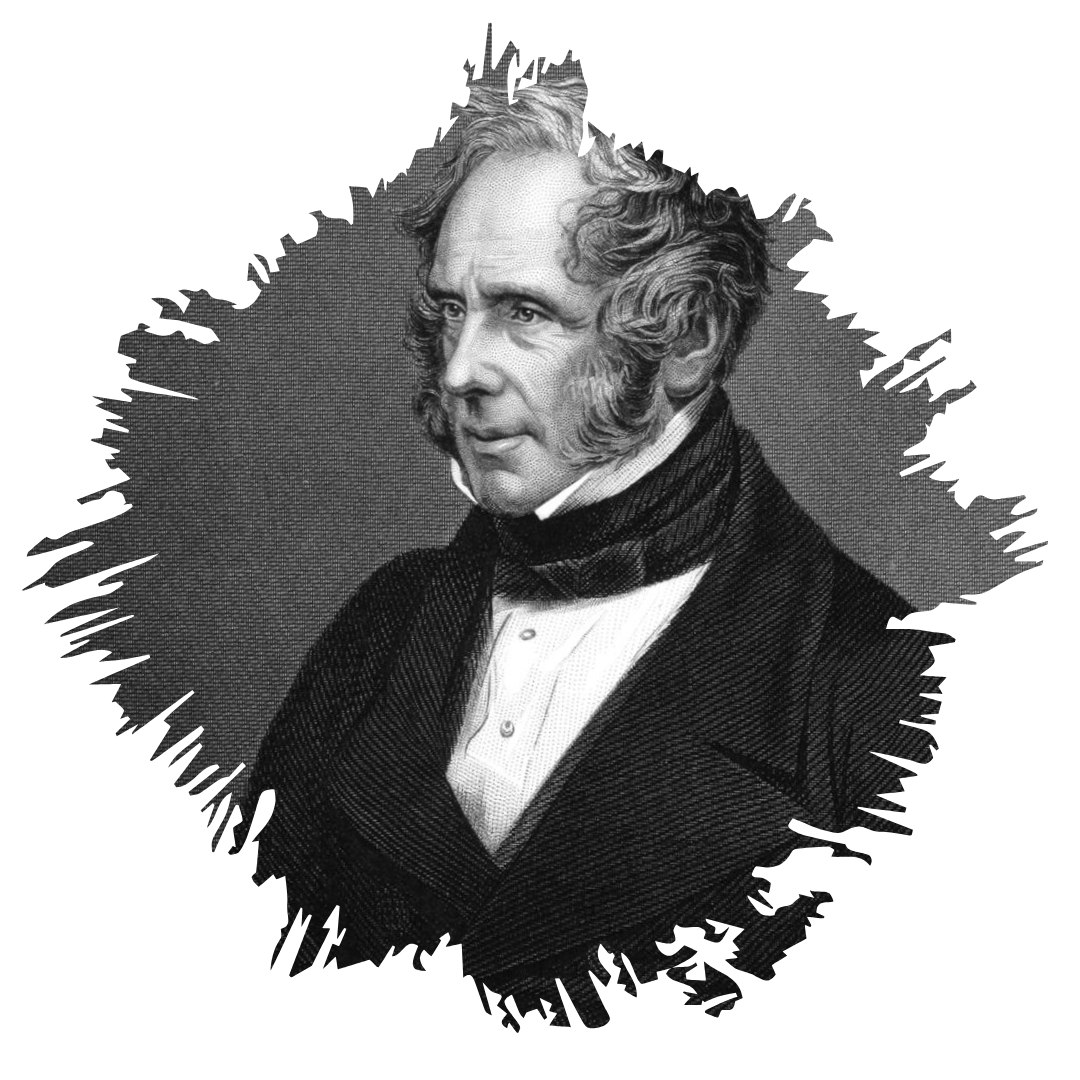
Upon receiving the first telegraph
message in the 1850s:
My God, this is the end of diplomacy!
British prime minister and foreign secretary
Protocol’s increasing accessibility thanks to the internet centres on the humane side of high-level meetings: how leaders get prepared, informal chats, smiles and jokes, walking from point A to B, cultural activities, encounters with ordinary citizens. This has the benefit of increasing the visibility and transparency of diplomacy to ordinary citizens, but at the same time it implies speeches drafted beforehand and scripted performances leave less space for genuine interaction, based on shared values and aimed at understanding each other’s needs. But pulling back the curtains removes the symbolism and status that surround diplomacy and elicit respect. This is why it is so difficult to reconcile the necessary cultural change away from elitism toward openness and transparency with the risk of turning diplomatic practice into a public theatre devoid not only of meaning but also of results.
The 2025 EU-China Summit confirms that protocol’s biggest success consists in the meeting taking place, without any incident. Thus, the meticulous preparations behind the scenes are largely absent from media coverage and International Relations research, relegated to practitioners’ level (with colourful stories abounding in ambassadors’ memoirs). However, culture plays a key role in state meetings (in addition to formal cultural diplomacy activities) - it surfaces through different customs around greeting (e.g. number of kisses or a handshake), honorific titles, eating, dressing, talking (language, pace, direct or not), and most importantly, values and beliefs. Rather than a fully rational exercise of national interests (as realist scholars would claim), International Relations depend on trust, emotions and personal connections (both between politicians, diplomats and protocol staff themselves). While countries move away from boosting cultural cooperation and towards security negotiations, it is key to recognise that protocol serves as the enabling environment, allowing all parties to participate on an equal footing.
This requires managing the EU's unique protocol position: it is treated as a supra-national entity in between states (the EU-China Summits are not given the status of state visits) and international organisations (EU complained when Trump’s first term seemed to lower its rank). Crucial negotiations may not start with a document but with an informal conversation - something the EU technocratic style is less prone to. In order to solve lingering internal coordination issues, it is pertinent that the institutions enact a common protocol manual and offer training to relevant staff. Another key difficulty derives from the EU's own diversity: having to choose only one national cuisine or dance to feature risks irritating Member States, and in practice leads to either spotlighting big ones or forfeiting cultural references at all. On some occasions, European diplomacy leans heavily on the former colonial power (Spain in Latin America or France in some parts of Africa), leading to negative perceptions. The EU needs to acknowledge its protocol's colonial roots and show utmost respect for the local cultures and interests, while vying for influence in a world polarised between the USA and China, as well as with xenophobic and discriminatory political discourse against migrants putting in question interculturality and their role as ambassadors of their cultures.
Diplomats posted to another country have the advantage of nearly full cultural immersion (which is also why they get rotated every 4-5 years - to avoid identifying more closely with the host's interests than their country's). Therefore, they are in the perfect position to aid visiting officials -lacking such cultural adaptation- to avoid common pitfalls and raise their awareness of the host culture, including mostly unwritten rules which are difficult to grasp from afar, and ultimately prevent unintended disrespect or actually devising a strategy to use protocol to send a subtle message. At the end of the day, preparing the leaders beforehand will be as important as their social skills.

In-person meetings remain the most effective way to establish interpersonal relations, despite the evolution of diplomacy in line with technology. Therefore, protocol still matters in a digitally-connected world, and holograms, AI avatars or metaverses are unlikely to alter this any time soon. Even if some meetings move online (with their own digital protocolary norms e.g. muting yourself while not speaking), any gaffe is broadcast and amplified for exponentially more reach, hence mandating stronger response. There is also an increasing need to balance what is open to the public and what retains diplomatic secrecy, avoiding turning protocol into a superficial performance. To nurture guanxi and affront common challenges -such as climate change or AI risks- despite inevitable divergencies, the EU and other countries need to rely on shared norms and understandings to engage smoothly.
This scrollytelling page has been programmed with the help of Claude AI. The tool has not been employed in the research or drafting process.
This analysis is a continuation of the author’s thesis The diplomatic protocol with Chinese characteristics: between the Confucian values and the foreign policy of great power, which examined the 2016 G20 meeting in Hangzhou as a case study.
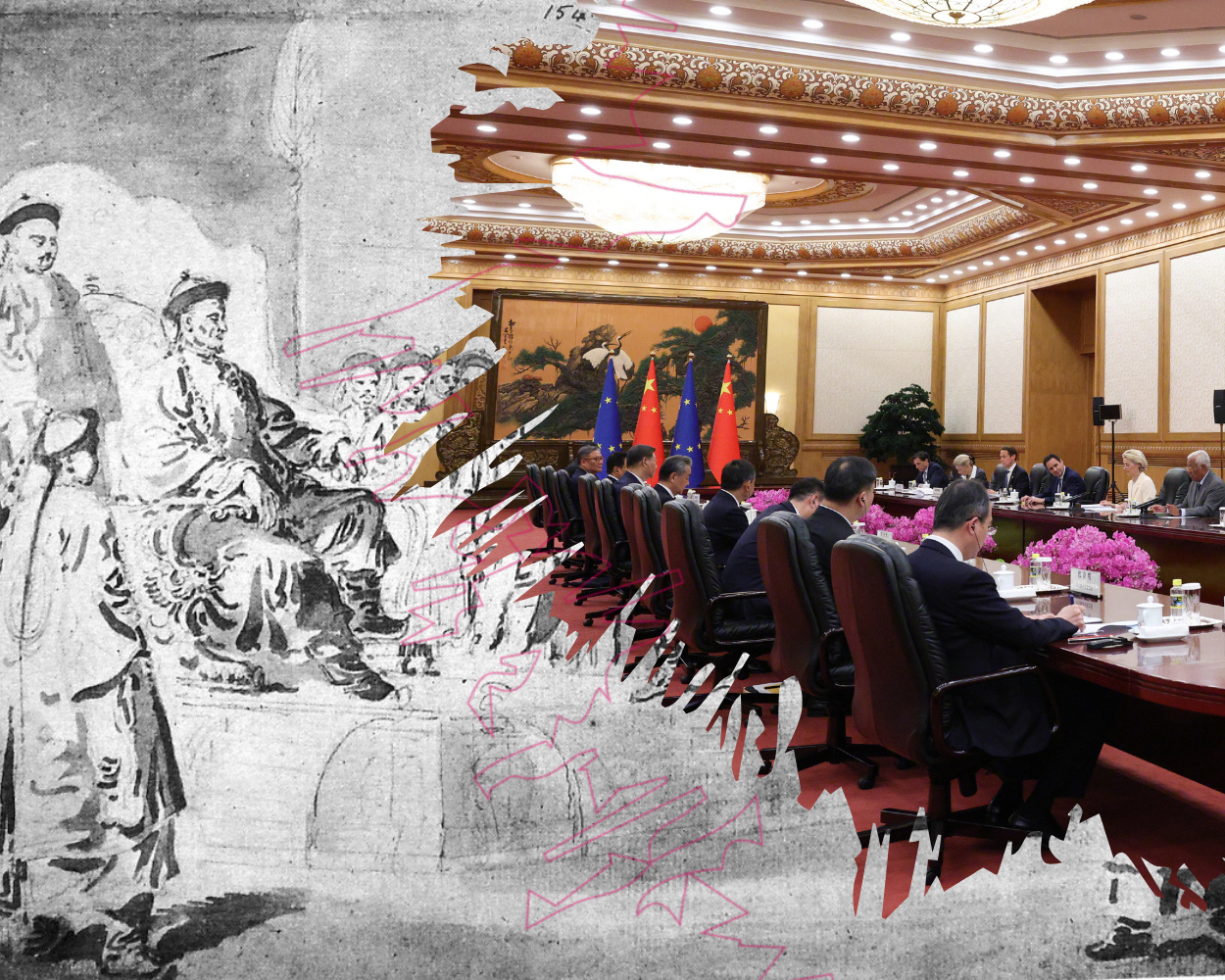
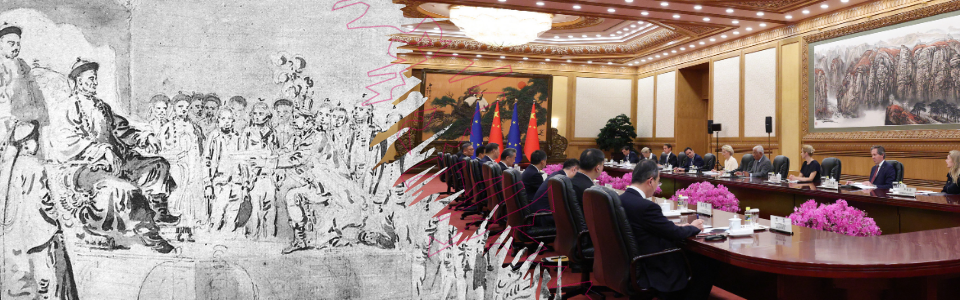
Top image credits: Left: Lord Macartney Embassy To China 1793 by William Alexander in “A study of History” by Arnold Toynbee / Right: European Council

Audio sources: European Council, nationalanthems.info, @antoniocosta.euco
The views expressed in this article are personal and are not the official position of culture Solutions as an organisation.