
Cultural relations under strain: Montenegro, Turkey and the EU: the resurgence of memory
This article examines how developments in 2025 reshaped cultural relations between Montenegro and Turkey, placing these changes within the broader context of EU enlargement and international cultural relations in the Western Balkans. Drawing on research into cultural engagement, collective memory, and EU accession processes, it explores how culture, heritage restoration, faith-based initiatives, and community-level exchanges increasingly intersect with contested historical narratives, identity debates, and mobility governance.
The analysis shows how moments of crisis can trigger collective memory and surface underlying tensions, turning everyday cultural engagement into a politically sensitive arena. It argues that Montenegrins could benefit from a more context-sensitive approach from regional powers and integration of memory perspectives into the EU integration process so that cultural action strengthens dialogue, pluralism, and social trust rather than remaining fragile or politically contested.
Montenegro–Turkey cultural relations in recent years
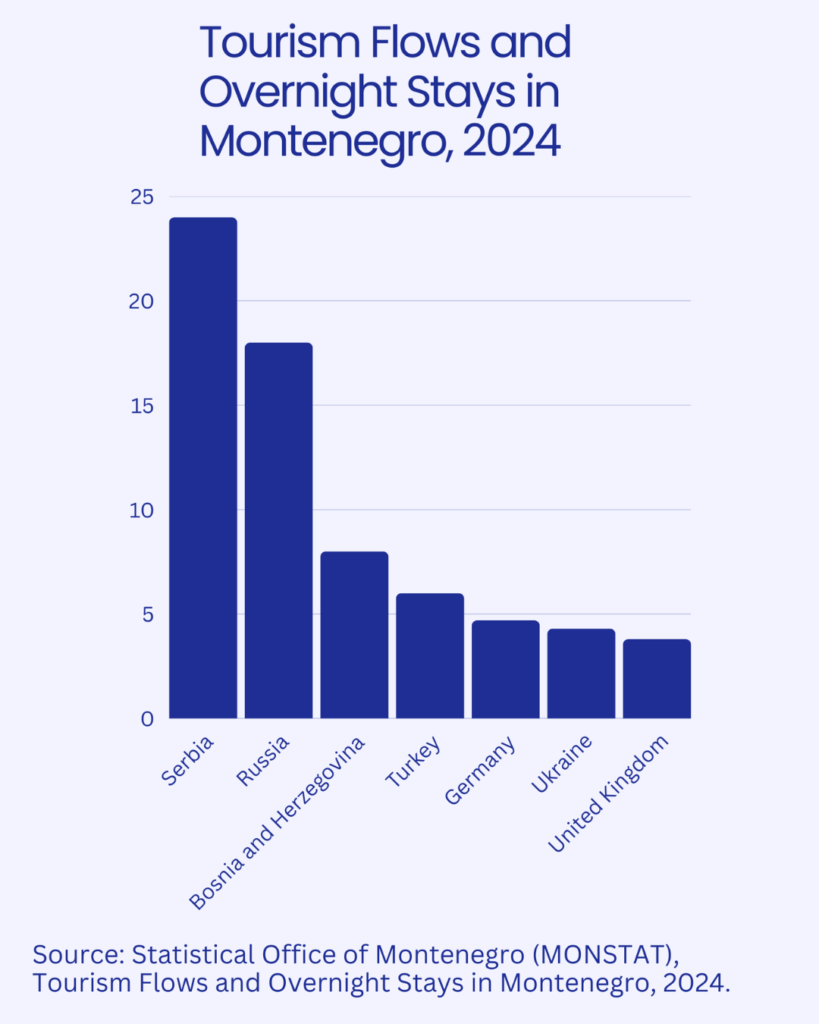
Since the early 2010s, cultural relations have emerged as a central dimension of Turkish engagement towards Montenegro, shaped by bottom-up cultural engagement, tourism, popular culture, and heritage-related initiatives. These dynamics have been particularly evident in the expansion of tourism and cultural consumption in everyday cultural interactions. Turkish television series are widely popular in Montenegro, circulating through regional media markets and contributing to sustained cultural familiarity. These exchanges have taken place in a plural setting of Montenegro, where ethnic and religious diversity —particularly among Montenegrin, Serbian, Albanian, and Muslim communities— has often intersected with political debates over foreign influence and cultural presence.
Turkey’s cultural engagement has also taken more institutionalised forms, particularly through initiatives in cultural heritage restoration and faith-based cultural relations. Institutions such as the Turkish Cooperation and Coordination Agency (TİKA), the Yunus Emre Institute, and the Diyanet have played a key role in preserving what Turkey frames as shared Ottoman-Islamic heritage. In Montenegro, this has included the restoration of religious and historical sites such as the Nizam Mosque and Osmanagić Mosque in Podgorica and the Semsi Pasha Mosque in Pljevlja. These efforts have primarily fostered engagement with Muslim communities through a combination of cultural, educational, and religious activities, including the provision of religious services and sustained community-level interaction. The Montenegrin President has expressed in the past that the shared historical and cultural heritage contributed to “a solid foundation for cooperation between Montenegro and Turkey”.
At the same time, these initiatives have been subject to politicised interpretations by parts of the political opposition and sections of the media in Montenegro, which frequently frame them as expressions of neo-Ottoman soft power. Such readings are often reinforced by historical narratives and collective memories associated with the Ottoman period, which continue to shape sensitivities toward Turkish involvement in the region. These sensitivities have become more pronounced as Montenegro advances along its EU accession path while simultaneously navigating the enduring influence of the Serbian Orthodox Church on debates over identity and belonging. As a result, cultural engagement that functions as a source of familiarity and connection for some segments of society is simultaneously perceived as politically charged, revealing the ambivalent and contested nature of Turkey’s cultural presence in Montenegro. As Jan Assmann argues, cultural memory is not a passive recollection of the past but a selective and socially mediated framework through which historical narratives are activated in the present.
An overnight incident that strained relations
In the evening of October 26th, 2025, Montenegro witnessed a weekend of chaos following an incident in a nightclub that led to the stabbing of a Montenegrin citizen (whose life is now safe) and the detention of 45 people, including Turkish and Azerbaijani citizens residing in Montenegro. The incident, followed by violence against the Turkish community, severely strained Turkish–Montenegrin relations, revealing a resurgence of anti-Turkish sentiment in the region, increasingly intertwined with religious intolerance toward Montenegro’s Muslim citizens.
Some opposition parties even accused Serbia of stoking the protests, pointing to rising friction between Belgrade and Ankara over an arms sale to Kosovo. In Montenegro, the Serbian community makes up nearly a third of the population and several political parties openly align with pro-Serbian positions. Their mobilisation capacity has been evident in previous large-scale protests and have contributed to political polarisation and institutional instability: trends repeatedly identified by the EU as challenges to Montenegro’s European integration trajectory.
Visa policies and EU accession process
The 26 October incident was soon followed by the Montenegrin government’s decision to reintroduce visa requirements for Turkish citizens (visa-free entry had been in place since 2008), until the visa-free travel was reinstated under stricter conditions on 23 December 2025.
For years, the EU had expected Montenegro to align its visa policy with Schengen rules, citing concerns about irregular migration from Turkey through the Western Balkans route. To fully harmonise its visa legislation with the EU, Montenegro is required to reintroduce visas for Turkish citizens. In the past, Montenegro had already abolished its visa-free regime with Kuwait, Egypt, Armenia, and Uzbekistan. In the Montenegro 2025 Report, the Commission considers Montenegrin visa exemptions to Bahrain, Uzbekistan and Saudi Arabia as a severe regression on the alignment with the EU’s visa policy. However, nowhere in the report were visas to Turkish citizens mentioned.
Balkans, Turkey, EU relations: which role for cultural action?
The Montenegrin–Turkish case demonstrates the domino effect of EU influence on cultural relations in Western Balkan accession countries. This dynamic reflects what de Sentenac describes as the “EU-isation” of candidate countries, through which accession-driven cultural policy frameworks progressively reshape how international cultural relations is structured. While cultural relations can support dialogue and interaction, they remain shaped by broader political and institutional dynamics and particularly vulnerable when underlying memory-related tensions are left unaddressed. Where memory is not acknowledged or critically engaged, cultural interaction is more likely to encounter persistent obstacles, limiting its capacity to generate durable trust and long-term cooperation.
For the EU, this highlights the need to integrate cultural relations more closely with questions of historical reconciliation, religious and identity-based pluralism, and mobility governance in the Western Balkans. EU cultural relations’ frameworks could place greater emphasis on supporting spaces for critical engagement with contested histories and on ensuring greater coherence between cultural cooperation and visa regimes. Treating mobility purely as a technical matter of alignment risks undermining the social trust that cultural relations are meant to foster.
For Turkey, the case points to the need for greater sensitivity to local political and memory contexts in its cultural engagement in the Western Balkans. While heritage restoration and faith-based cultural relations have contributed to the consolidation of cultural presence, they also operate within contested and minority memory environments. A more pluralistic and local approach that acknowledges sensitivities beyond past imperial narratives could help address politicised interpretations and enhance the sustainability of cultural relations. Cultural actions and policies can function as a stabilising force in the Balkans only if they directly engage with diversity, memory, identity, and mobility; otherwise, it remains fragile, reversible, and politically vulnerable.
The views expressed in this article are personal and are not the official position of culture Solutions as an organisation.
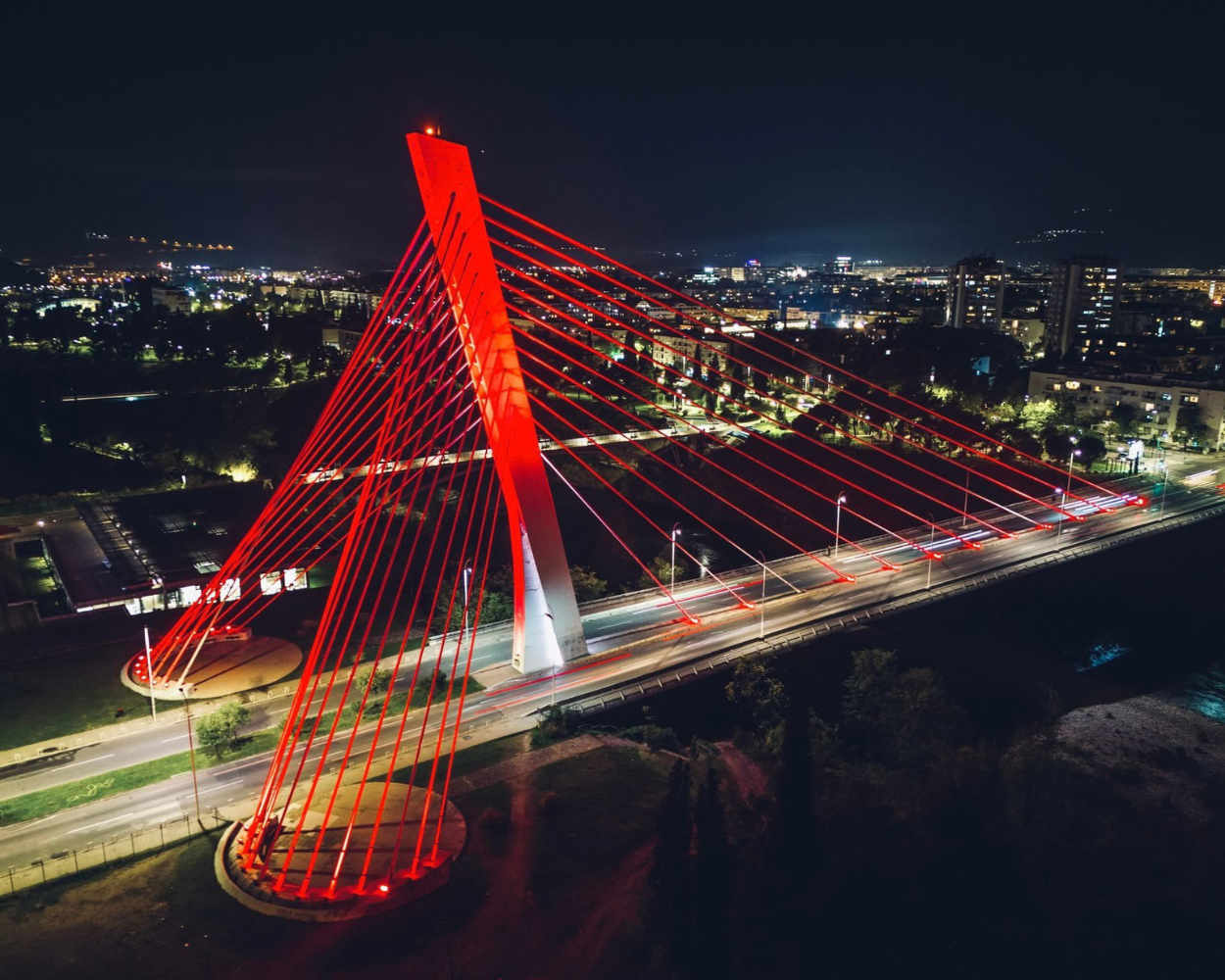
Image: Podgorica’s Millennium Bridge illuminated in red to commemorate Turkey’s Republic Day, three days after demonstrations targeting Turkish citizens in the city.